How Anchorage Became One
From 1964 to 1975, the City of Anchorage and the Greater Anchorage Area Borough (GAAB) operated as separate and often conflicting local governments. Service gaps and jurisdictional conflicts created confusion – police, zoning, and building code enforcement varied widely depending on location, from even one side of a street to another.
Serious official interest in unifying the Anchorage area under a single government dates back to at least 1965. In 1969–1971, an Anchorage Area Charter Commission drafted a proposal to unify the City and Borough, but the electorate rejected it. However, a new Greater Anchorage Area Borough Charter Commission formed in 1975, revised the charter, and presented a more streamlined and inclusive version to voters – this time, with success.
Read the Charter as approved by voters, signed on September 16, 1975.
Why Unify?
The push to unify the City and Borough was driven by practical governance challenges, inequities in services, and a growing desire to use public resources more efficiently.
Before unification, Anchorage had two overlapping local governments:
-
The City of Anchorage (incorporated in 1920), which managed police, fire, zoning, and other municipal services in the urban core.
-
The Greater Anchorage Area Borough (GAAB) (created in 1964), which oversaw regional services like planning and solid waste outside city limits.
This overlap led to duplication and jurisdictional confusion. Residents and developers, particularly in border areas, often didn't know which entity to contact for services or permits. A homeowner might have GAAB garbage service, City fire protection, and inconsistent law enforcement, depending on their address. Anchorage's continued rapid growth, driven in part by the North Slope oil boom, demanded coordinated planning. Fragmented governance made it difficult to manage sprawl, build infrastructure, and zone land effectively. Unification promised consistency, smarter land-use decisions, and more coordinated growth. Read the August 1975 study on duplicate services and government overlap.
History Takes: Wilda Hudson
Wilda Hudson, who served on both the City Council and the Borough Assembly during the period leading up to the merger, described the dual‑government structure as dysfunctional:
“Meetings lasted until the wee hours. There were weeks when the Assembly would vote to sue the city about something – city sewer line extensions, maybe – on Monday night, and the council would vote to sue the borough about the same thing on Tuesday night."
Hudson's critique reflects broader frustrations held by proponents who saw unification as necessary to end wasteful feuds between overlapping jurisdictions.
Taxation and equity also played a key role. Some Borough residents received services but did not pay City taxes. Conversely, many City residents felt they were subsidizing services for the surrounding region. Unification proposed a single government and tax base to better align services with revenue and create a more equitable system.
And finally, dual governance was simply unwieldy. Two assemblies, two mayors, and multiple bureaucracies made decision-making slow and inefficient. Supporters believed that a single, streamlined government would be more accountable and responsive to residents.
WALLS OF FLAME SWEEP LENGTH OF MOTEL - Searing flames quickly destroyed the Gold Rush Motor Lodge on Northern Lights Boulevard, at the southern City limits of Anchorage today, sweeping from the front dining room area at the right of photo along the length of building, to the left in the picture. State Troopers reported that 34 rooms, were occupied when the fire broke out, with between 40 and 43 persons in the building on the time. January 1970, credit of Anchorage Daily News.
The January 13, 1970 Gold Rush Motor Lodge fire represented the worst ramifications of governance disarray. The hotel was on the south side of Northern Lights Boulevard, the border between the City and GAAB. City firefighters responded to the call, but the Gold Rush was outside their service area. Some individual firefighters entered the fire, but the commander, most of the crew, and a fire truck waited out the disaster across the street. Five people died. The tragedy galvanized support for unification, though the process endured through several failed votes and five more years.
Who Opposed Unification – and Why
While many supported the unification of Anchorage and the Greater Anchorage Area Borough, the 1975 effort also faced strong opposition from various groups with different concerns.
Residents of outlying communities such as Eagle River, Chugiak, and Girdwood feared losing local control and being subjected to urban-centered policies. They worried about paying higher taxes for services like police or public transit that they didn't necessarily use or need. Many feared that unification would concentrate political power in Anchorage's urban core, marginalizing rural voices.
Some employees of both the City of Anchorage and GAAB opposed the merger out of concern for their jobs. Merging departments raised the possibility of layoffs or reassignment. Some people feared the creation of a larger, more costly bureaucracy while developers and small-government advocates objected to what they saw as increased regulation. Some developers and contractors in outlying areas didn't want to be subject to stricter City zoning and permitting rules.
Even some who supported unification in principle opposed the 1975 version of the charter. Critics worried it gave too much power to the mayor or failed to protect minority representation and rural interests. Still, despite these concerns, the political climate and urgency of growth shifted the momentum.
How it Passed – And What Came Next
Despite opposition, the pro-unification argument was ultimately more persuasive. The failure of the earlier votes in 1970 and 1971 helped to refine the process. The 1975 Charter Commission, which included leaders such as Jane Angvik and Lisa Parker, made a concerted effort to engage the public, address previous criticisms, and simplify the proposed structure.
Anchorage's rapid expansion, along with the economic pressures and optimism generated by the oil pipeline boom, made the case for reform even stronger. Civic leaders emphasized that unification would benefit all residents, not just those living in the urban core.
In a special election held in September 1975, voters approved the measure and on September 15, 1975, the City of Anchorage and the Greater Anchorage Area Borough officially merged to form the Municipality of Anchorage. Today, the Municipality spans nearly 1,961 square miles, encompassing urban neighborhoods, military bases, suburban communities, and vast wilderness areas. It is home to roughly 40% of Alaska's population.
As a home-rule municipality, Anchorage operates under a local charter designed to promote transparency, fairness, and community involvement. The preamble of the Charter reads:
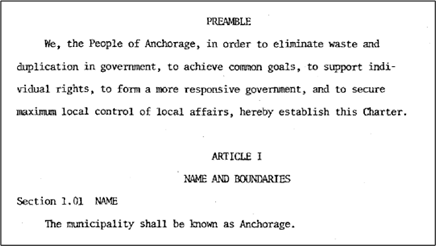
The 1975 Charter established key provisions to support citizen participation and government accountability, including:
-
Municipal Ombudsman
The Anchorage Charter requires an independent Ombudsman, responsible to the Assembly, to investigate municipal agencies and recommend improvements. This office ensures residents have a clear and impartial avenue to raise concerns and seek redress. -
Municipal Boards & Commissions
The Charter mandates a robust system of boards and commissions to engage the public in policymaking and oversight. These bodies allow residents to advise on many community issues, from urban design to public health. -
Community Councils
Anchorage's system of community councils – geographically defined, grassroots advisory bodies – ensures that neighborhoods have a voice in local decisions. Councils represent residents, property owners, businesses, and nonprofits, creating a strong link between government and community.
The 1975 unification of Anchorage and the Greater Anchorage Area Borough was one of the most consequential changes in Alaska's local governance history. While not without controversy, the merger created a foundation for a cohesive and participatory municipal government. Fifty years later, Anchorage's unified structure continues to shape the city's ability to plan regionally, deliver services, and include residents in the decisions that affect their daily lives.
This article was written by Legislative Services staffer Jennifer Veneklasen, in consultation with local historian and guest contributor David Reamer.
Published by the Assembly Legislative Services Office
We believe that local government plays a critical role in improving our community and that it works best when residents are engaged. We provide research, communications, and project management on behalf of the Anchorage Assembly to engage our community in local government. Learn more.