History Takes: Darrel Hess
Darrel Hess arrived in Anchorage with his family in August 1965, at the age of 12. After working in the private sector for many years, Darrel was hired by Mayor Mark Begich as a Project Manager in the Office of Economic & Community Development. Mayor Dan Sullivan appointed Darrel as Anchorage's first Homeless Coordinator in August 2009. Darrel was appointed Municipal Ombudsman in August 2012 and continues to serve in that position. Darrel served as a member of the Anchorage Equal Rights Commission from 2010 to 2024, including a term as chair.
After years of complaining about a confusing, inefficient city–borough government structure, on September 9, 1975 the voters in the City of Anchorage and Greater Anchorage Area Borough went to the polls and voted to approve the proposed Anchorage Home Rule Charter and unify as the Municipality of Anchorage. Unification came into effect on September 16, 1975. In its preamble, one of the reasons articulated for establishing the Charter was to “support individual rights." Accordingly, the visionary members of the Anchorage Charter Commission included language to establish community councils, the Office of the Ombudsman, and the Anchorage Equal Rights Commission.
Charter Section 17.01 states that “The assembly shall enact ordinances against invidious discrimination in housing, public accommodations, employment, education, and financing practices on the basis of race, religion, age, sex, color, national origin, marital status, or physical disability". Section 17.02 states, in part, that “The assembly by ordinance shall establish an equal rights commission and prescribe its duties." The Charter's Bill of Rights states that the people of Anchorage have the right to the services of an equal rights commission to aid them with discrimination complaints.
Anchorage Ordinance 203-76, which established the Anchorage Equal Rights Commission, and its powers and duties, was passed and approved by the Anchorage Assembly on November 9, 1976 (my 24th birthday). Why did it take 14 months after voter approval of the Charter and unification for the AERC to be established in code? The road to establishing the AERC was long, winding, and bumpy. Remembering the community debate and dialogue around establishing the AERC revives painful memories for me, and the ordinance that passed was not the birthday present that I had hoped for.
The First Attempt
The first draft ordinance to establish the AERC, AO 77-75, was introduced on December 16, 1975. Section 1 of the ordinance stated that “The public policy of Anchorage is declared to be equal opportunity for all persons. The Anchorage Assembly finds that discrimination in employment, housing, public accommodations, education, and financing practices based upon race, color, sex, religion, national origin, marital status, age, or physical handicap adversely affects the welfare of this community. Accordingly, such discrimination is prohibited."
In the definitions section of the ordinance, “Sex Discrimination" was defined to mean “differential or preferential treatment shown towards a person because of one's sex, pregnancy, parenthood, or sexual preference." The inclusion of sexual preference was a bold move in 1975 America. The outgoing City Human Relations Commission had worked diligently to craft the ordinance, and it had included sexual preference in the definition of sex discrimination, an acknowledgement of the discrimination faced by members of the gay community in Anchorage. Across the nation, many people's views of gay people had been changing. The Stonewall Riots took place on June 28, 1969, and the first gay pride celebration, the Christopher Street Liberation Day March, occurred in New York City on June 28, 1970. The riots and the march gave birth to the gay rights movement in America. In 1973, the American Psychiatric Association removed homosexuality from its list of mental disorders.
Anchorage Mayor George Sullivan was deeply opposed to equal rights for gays and lesbians. In 1976, Sullivan ordered references to the Alaska Gay Coalition removed from the Anchorage Blue Book, a local service guide. The Coalition successfully sued, and the Alaska Supreme Court ruled the removal was unconstitutional in 1978. On the witness stand, Sullivan described gays as “repugnant."
Unsurprisingly, Sullivan did not support including sexual preference in the definition of sex discrimination and had the reference removed from the draft ordinance crafted by the Human Relations Commission. The public hearing for AO 77-75 was held on December 30th, and most of the testimony supported including sexual preference in the ordinance. Some brave members of the community, who self-identified as gay, provided testimony about their experiences with discrimination in Anchorage. Outgoing Human Relations Commissioner Heather Flynn expressed her admiration for those who had testified and urged the Assembly to pass the ordinance with sexual preference included. Assemblymember Lidia Selkregg moved to reinstate “sexual preference" into the ordinance, and the members approved her amendment. The Assembly then unanimously approved AO 77-75, to cheers and applause from those in the audience. Members of the gay community felt like they now had some legal protections against discrimination.
Mayor George Sullivan vetoed the ordinance on January 6, 1976. In his veto message, Mayor Sullivan stated that the ordinance passed by the Assembly “bars discrimination of any sort based on any type of sexual deviation."
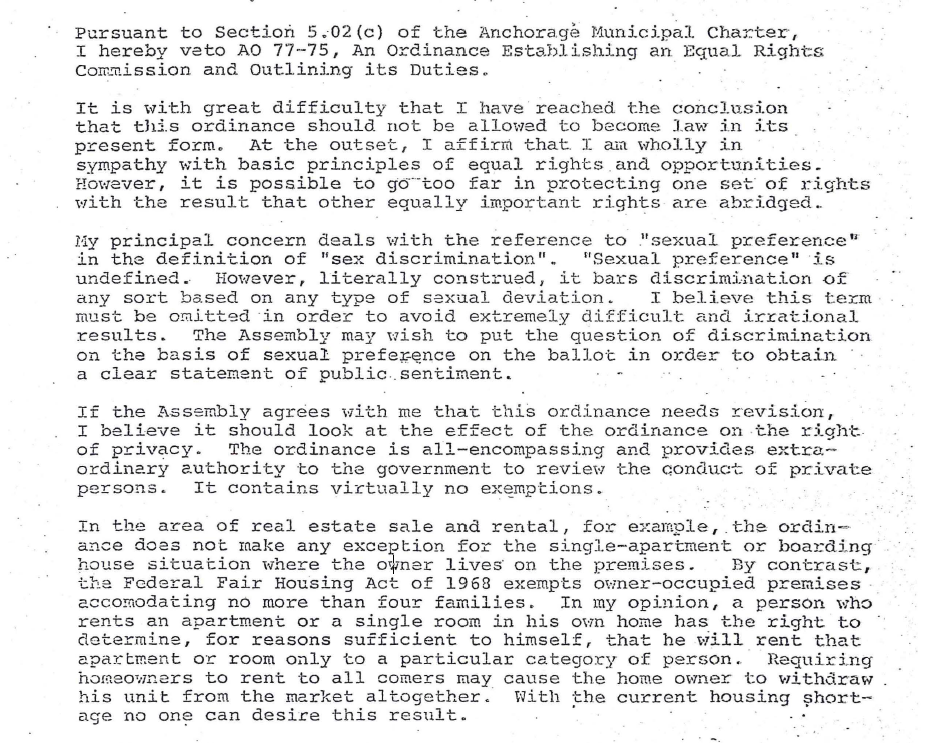
An excerpt from Mayor Sullivan's veto message of AO 2025-77
The local gay community felt betrayed by the Mayor's veto; the Mayor was telling the public that it was OK to discriminate against them, because they were sexual deviates. As a 23-year-old closeted gay man, the veto by the Mayor that I had voted for felt like a stab in the heart. At the January 6th Assembly meeting, people attended in support of the Mayor's veto, and to express their opposition to the veto. Certain members of the clergy testified in support of the veto and started a decades-long campaign opposing the inclusion of protections for the gay community in Title 5.
In interviews and letters to the newspapers, conservative community members demanded recall petitions against Selkregg and other Assembly members who voted in favor of the ordinance. She noted that she had received threatening and abusive telephone calls as “a woman from a foreign country." She stated that the ordinance was “a very basic part of government expressing the most basic freedoms of people."
A motion to override the Mayor's veto was introduced and then tabled during the January 20th Assembly meeting. During the override debate, Assemblymember Tony Knowles noted that it is not the purpose of government to overtly or tacitly be the tool of any one group. He stated that the key is equal protection under the law, extended to all the people; that is the mandate of government. Selkregg noted that she would be voting to override the Mayor's veto because she felt that the sexual preference issue had introduced bigotry into our community, and she did not stand for bigotry.
History Takes: Tony Knowles
During the January 20, 1976 Assembly meeting, then-Assembly Member Tony Knowles said:
“To those who would have this Assembly guarantee rights to some but deny those rights to others, they ask not for governmental restraint, but in fact, are requesting the government, by turning the other way, to become a silent partner in forcefully promoting the will of one group upon another. I will not take part in this complicity.”
During that same meeting, Assemblymember Don Smith introduced AR 4-76, which would have submitted to the voters the “question of implementing an ordinance prohibiting discrimination based on sexual preference." A majority of the Assembly members rejected the resolution. That same evening, three ordinances to establish the AERC were introduced: AO 5-76, AO 6-76, and AO 7-76.
The Second, Third, Fourth and Fifth Attempts
Smith introduced AO 5-76. The ordinance did not include “sexual preference" in the definition of “Sex Discrimination." Assemblymember Fred Chei introduced AO 6-76. In the memorandum accompanying his ordinance, Chiei questioned why sexual preference was included in the vetoed ordinance while the rights of convicted felons who have done their time, the rights of former gamblers and prostitutes, and the rights of former inmates of insane asylums were not delineated in the ordinance. Chiei further noted that, “Setting aside the morality issue, which cannot be legislated within an ordinance; all these persons are entitled to an equal opportunity right.". The ordinance did not include “sexual preference" in the definition of “Sex Discrimination."
The Human Relations Commission prepared AO 7-76, the fourth attempt to establish the AERC, which was moved by Selkregg and seconded by Knowles. The definition of “Sex Discrimination" in the ordinance included “private sexual preference." AO 12-76, the fifth attempt to establish the AERC, was laid on the table by Assemblymember Ernie Brannon on February 10th. The ordinance did not include “sexual preference" or “private sexual preference" in the definition of “Sex Discrimination."
The combined public hearing for AO 5-76, AO 6-76, AO 7-76, and AO 12-76 was held on February 10th. The public testimony was long, contentious, and passionate. Several religious leaders testified against the “homosexual" ordinance and warned of dangers from sodomites and deviates. Multiple persons spoke in support of AO 7-76, which included private sexual preference in the definition of sex discrimination. The Citizens for A Human Rights Committee submitted a petition with 400 signatures that supported including sexual preference in the ordinance.
Two weeks later, on February 24th, a majority of Assembly Members rejected AO 5-76, AO 6-76, and AO 12-76. AO 7-76 was approved by a majority of Assembly members, with Knowles, Selkregg, Ernie Brannon, George Dickson, Dick Hart, Ben Marsh, and Dave Rose voting “Aye." Assembly members Chiei, Smith, Bill Besser, and James Campbell voted “Nay."
Mayor Sullivan vetoed the ordinance on March 2nd. In his veto message, Sullivan stated that “My basic reason for vetoing this ordinance is the inclusion of the 'sexual preference' provision which has caused such controversy for a number of months in this community. It has been and remains my conviction that the people of Anchorage should not be forced to associate with sexual deviates."
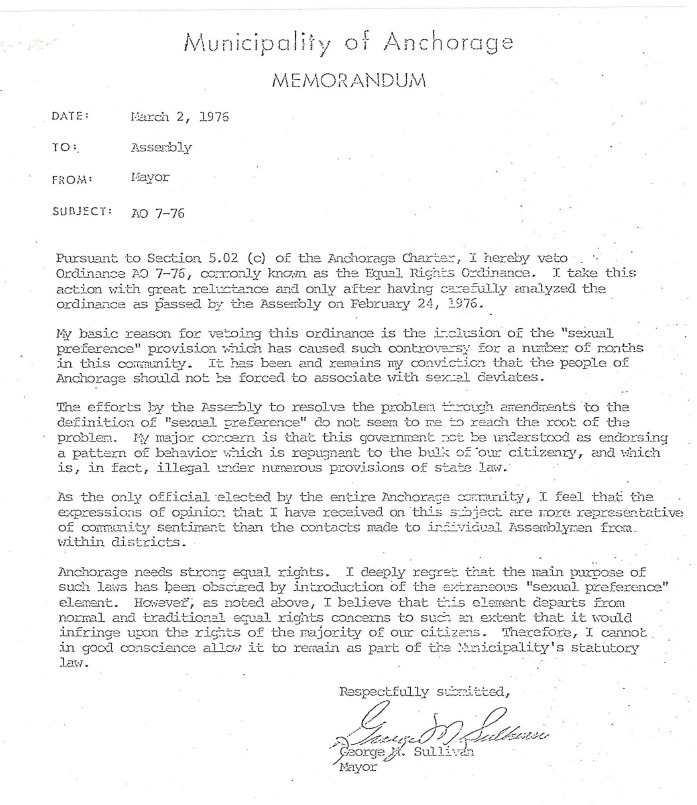
The Assembly majority could not muster the votes to override the veto on March 23rd.
The debate continued to rage in the community for the next several months, as the Assembly Members who supported including protections for the gay community in Title 5 could not muster enough votes to pass an ordinance that included sexual preference and could survive a certain veto by Sullivan. Members of the gay community were being told by their elected Mayor that they were deviates, that their community should not be forced to associate with; that it should be OK to deny them services in housing, employment, financing, or public accommodations. All the while, it was becoming apparent that there was a need in the community to establish the AERC and address discrimination complaints. Policymakers and community members felt like they were caught between the proverbial rock and a hard place.
Finally...
AO 203-76, the sixth attempt to establish the AERC, was introduced at the request of the Mayor on October 10th. The ordinance did not include “sexual preference" or “private sexual preference" in the definition of “Sex Discrimination." The public hearing was held on November 9th with more passionate testimony from both sides of the issue. Without sexual preference included in the ordinance, fewer people testified. Given the mood in the community and the Assembly majority's inability to override a potential veto, the outcome was a foregone conclusion. The ordinance was approved 10-1, with only Assemblymember Smith voting “Nay."
For the brave members of the gay community who had outed themselves with their testimony, who had risked their jobs and housing, their exclusion from the protections of Title 5 left them vulnerable and branded as deviates by the Mayor of Anchorage. They were told that there was not a place for them at Anchorage's table of equality. It would take another 39 years, and multiple ordinances, vetoes, and ballot initiatives before AO 2015-96(S-1), As Amended, adding sexual orientation and gender identity as protected classes under Anchorage Title 5 – Equal Rights was approved by the Anchorage Assembly on September 29, 2015.
This month, as our community celebrates the 50th Anniversary of Munification, we should also celebrate the 10th Anniversary of the long-delayed expansion of equal rights in our community.
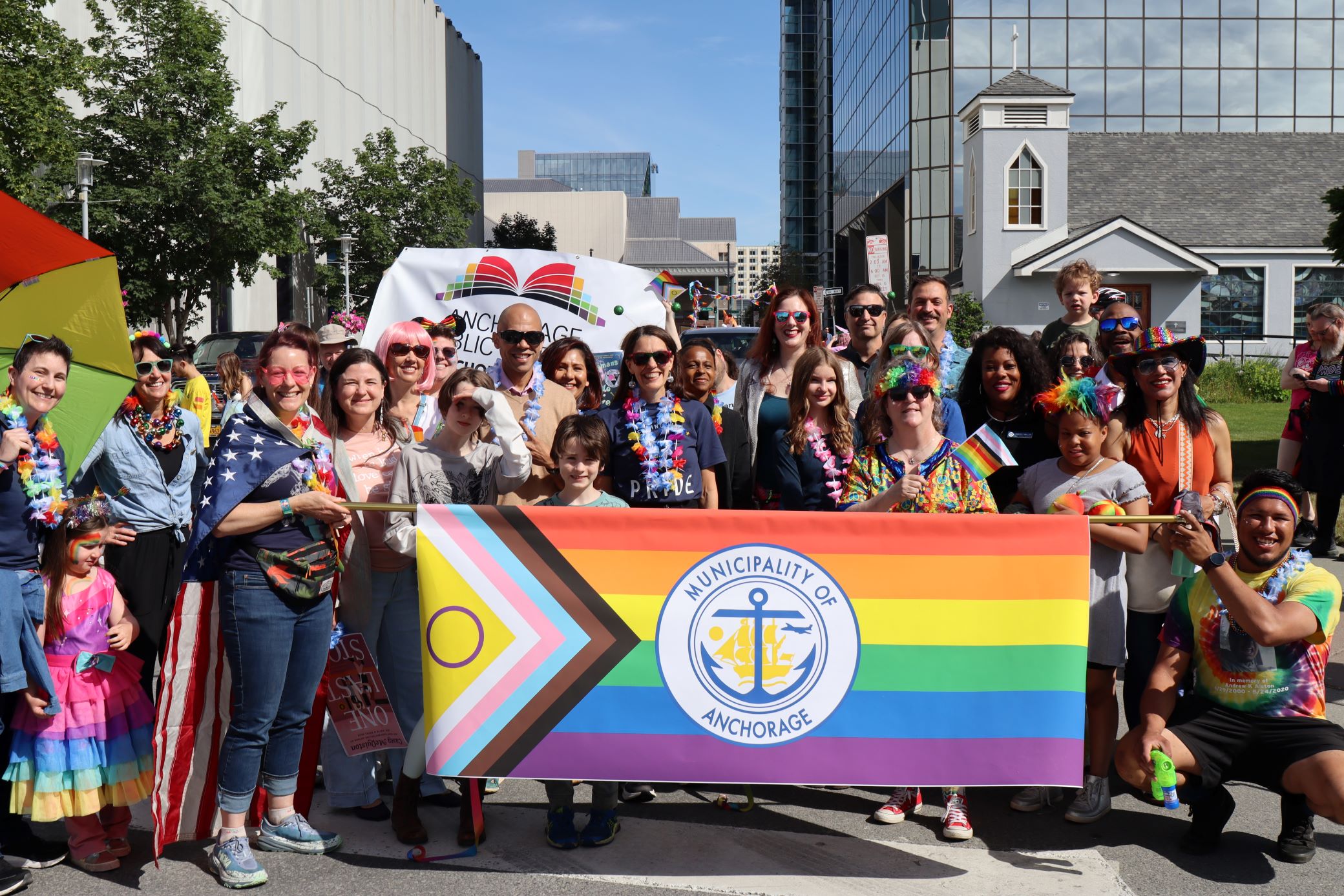
June 28, 2025 - Municipality of Anchorage staff and extended family march in the Anchorage Pride Parade.
Have you suffered discrimination at your job, in your housing, or at a local business, school, financial institution or governmental agency within the Municipality of Anchorage? The
Anchorage Equal Rights Commission provides free and confidential services to the public in cases involving discrimination and harassment.
Published by the Assembly Legislative Services Office
We believe that local government plays a critical role in improving our community and that it works best when residents are engaged. We provide research, communications, and project management on behalf of the Anchorage Assembly to engage our community in local government. Learn more.