Why Care About Local Government?
Local government affects our daily lives – fire and police response times, the frequency of road plowing, library hours, and the quality of our parks – are all determined at the local level. Our local government belongs to all of us and we all have a voice in shaping the future of the Municipality of Anchorage.
Local government is accessible. If you bring a good idea to an Assembly Member, the Mayor or a Municipal department director, you’ll often get a response and you might even see your idea implemented. Plus, cities and states across the country learn from each other, so if something is done well in Anchorage, it might be picked up by other places across the country. If you start local, you never know how far your idea might go!
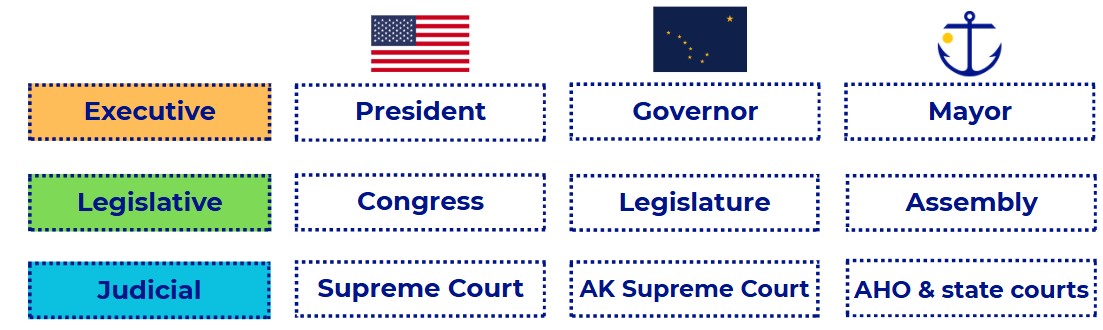
What is Local Government?
Our local government is the Municipality of Anchorage, which stretches from the Knik River in the north to the end of Turnagain Arm in the South. It is a mayor-council form of government with executive (mayor) and legislative (assembly) branches that are equal branches. The Executive Branch is overseen by a Mayor and the Legislative Branch is represented by two Assembly Members per district, with six districts. Each Assembly District has approximately 48,000 residents. The Mayor and Assembly are nonpartisan posts with terms that last for three-years. Anchorage has term limits and the Mayor can serve up to two terms and Assembly Members can serve up to three terms.
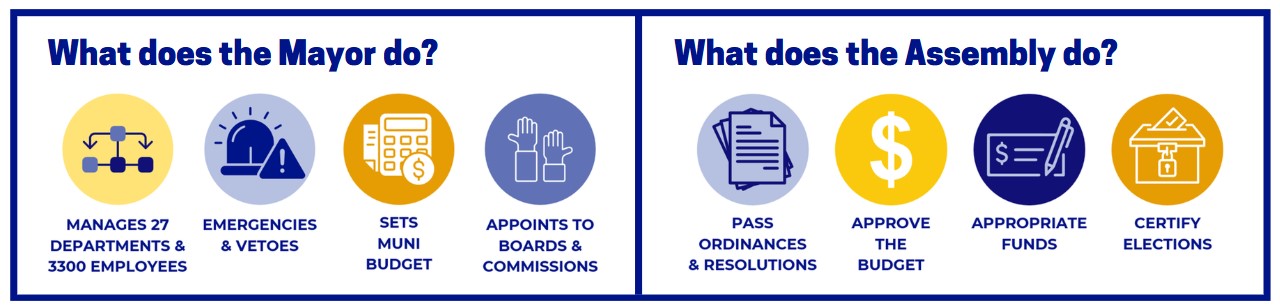
The Assembly sets the overall policy direction for the Municipality of Anchorage by adopting ordinances that become our local laws, adopting the annual budget, which determines what services are provided, and providing oversight of the executive branch. The Assembly exercises its legislative authority at Assembly Meetings, which are held twice a month on Tuesday evenings.
The Mayor implements Municipal policies and manages the departments that provide municipal services like road maintenance, public health and safety, and parks and libraries. The Mayor also sets the Municipal budget and appoints members of the commuity to serve on the Boards and Commissions that advise departments.
.png)
Other Forms of Local Government
Anchorage School District
About 46% of Municipal property taxes go to fund public education at the Anchorage School District. The School District is run by a Superintendent and a 7-member Anchorage School Board. School Board Members are elected citywide and serve 3-year terms. They meet twice a month, usually on the first and third Tuesday, and set the direction of the District, oversee the Superintendent and set policies and budgets. The Assembly and the School Board have a government-to-government relationship and hold quarterly joint meetings. The Assembly approves the ASD Budget after it is approved by the School Board, but only the top-line amount is approved by the Assembly and the School Board makes all line-item decisions, including cuts.
Tribal Government
The federally recognized tribal government in Anchorage is the Native Village of Eklutna. The Muni and the Village have a government-to-government relationship for consultation and collaboration. The Native Village of Eklutna operates under a constitution with a Tribal Council (legislative), Rule Keepers (judicial) and Council President, Vice President, Secretary & Treasurer (executive).
Community Councils
Each neighborhood in the Municipality has a community council – anyone can attend! It’s where neighbors come together to chat, share ideas and provide input on issues. Find your council and get involved: www.communitycouncils.org.
Get Involved
If you want to get more involved, the first place to start is to be informed on local issues. You can learn about the Assembly’s work at
muni.org/assembly and the Mayor’s priorities at
muni.org/mayor. You can also provide feedback to the
Anchorage School Board and participate in your local community council (
communitycouncils.org) to learn about neighborhood issues and meet with neighbors.
If you have time to give, you can volunteer for a municipal department or a school, serve on a board or commission, give input on a park or neighborhood plan, or email the Mayor, Assembly or School Board Member with a question or suggestion.
Tips for Impact
Once you are ready to share your idea or suggestion, here are some tips for impact:
- Keep your testimony/email succinct so your idea can easily be understood
- Share how the issue will personally impact you
- It’s okay if you don’t know all the details, but just want to say “I support this” or “I don’t support this”
- Learn more at our Guide to Testimony at muni.org/assembly
Learn More
Now that you know the basics, here's where you can find more information: