History Takes: Alex Slivka
Alex Slivka has more than 40 years of experience in accounting, finance, and investments. He served as the Municipality of Anchorage’s Chief Fiscal Officer from 2018 to 2021 and, in 2023, became Chief Financial Officer of the University of Alaska Foundation. A member of the MOA Trust Board, Slivka is also deeply committed to community engagement, having served as a trustee, board member, officer, mentor, and volunteer for organizations including Covenant House Alaska, the Alaska Community Foundation, and the Anchorage School District.
In my role as a citizen of Anchorage since 1997, and as the Municipality of Anchorage's Chief Fiscal Officer from 2018 to 2021, I have benefited from the thoughtful community that enacted the tax cap in 1983, only a few years after the merger with the Borough in 1975.
I always find that context can be helpful. Citizens have been paying property taxes for as long as there have been communities … going all the way back to Mesopotamia and Egypt 3000 BCE. Just like today, these taxes were used to support community needs (e.g., wells, grain storage, and pyramids). And like today, people are always concerned about how much tax is levied. Every State in the U.S. has some form of property tax, and 46 out of the 50 states also have some form of control over how much tax can be assessed.
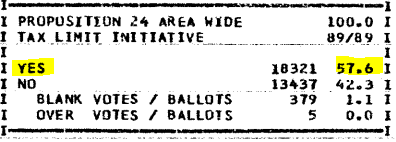
Approved by voters in 1983, our tax cap links taxation to population growth and the rate of inflation. The thought being that more people mean more services are needed, and that linking to the rate of inflation allows the continued provision of these services despite rising expenses. Equally important, as other forms of taxation were implemented (e.g., automobile, tobacco, marijuana, motor vehicle rental) they actually reduced the amount of property tax that could be collected.
Watch: Slivka’s 7-minute presentation at City Nerd Nite: “Money Money Money” explaining how the tax cap is calculated.
I believe the tax cap has been helpful on many fronts:
- It gives homeowners comfort that their taxes will not rise too fast;
- It gives the Mayor/Assembly some certainty on the available revenue from year to year;
- This certainty allows the City to recruit and retain exceptional employees.
Something less evident to the property owner is that the tax cap, when combined with the need to balance the municipal budget every year, resulted in a conservative approach to spending and a capital structure that for many years was AAA rated. This conservative structure also lead to lower costs for the community as the interest rates we pay on voter-approved borrowing stayed low.
This does mean that conversations regarding the priorities of the community are very thorough as the funds will necessarily be limited.
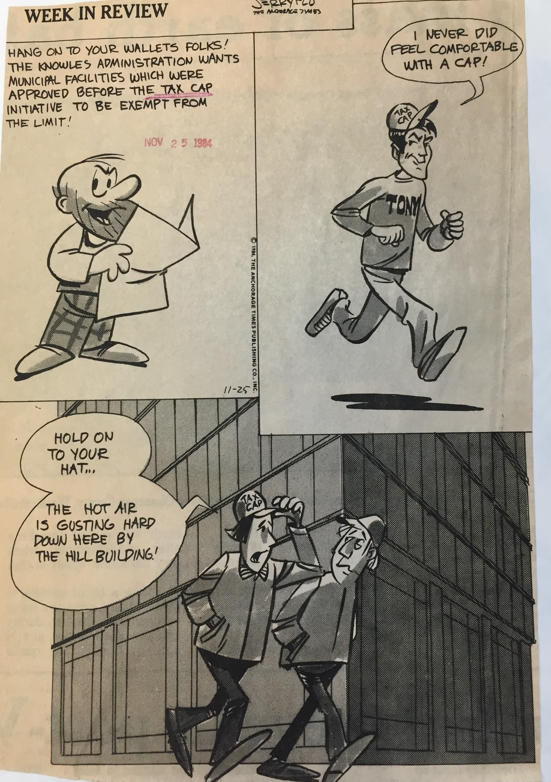
November 25, 1984 - A cartoon from The Anchorage Times (1984) commenting on implementation hiccups following the approval of the tax cap in 1983. Days after the cartoon was published, the Assembly approved
AO 1984-208(S-A), As Amended to establish guidelines and procedures for the tax cap.
Looking at my own experience, in the seven years from 2018 to 2025 property valuations increased by about 25% while property taxes only went up by 16%, or about 2% per year. This means that the amount of tax per $100,000 of value (also known at the mil rate) has actually declined.
Finally, the tax cap helps prevent the scariest possibility: being forced to move when property taxes rise too much, which has happened in other states.
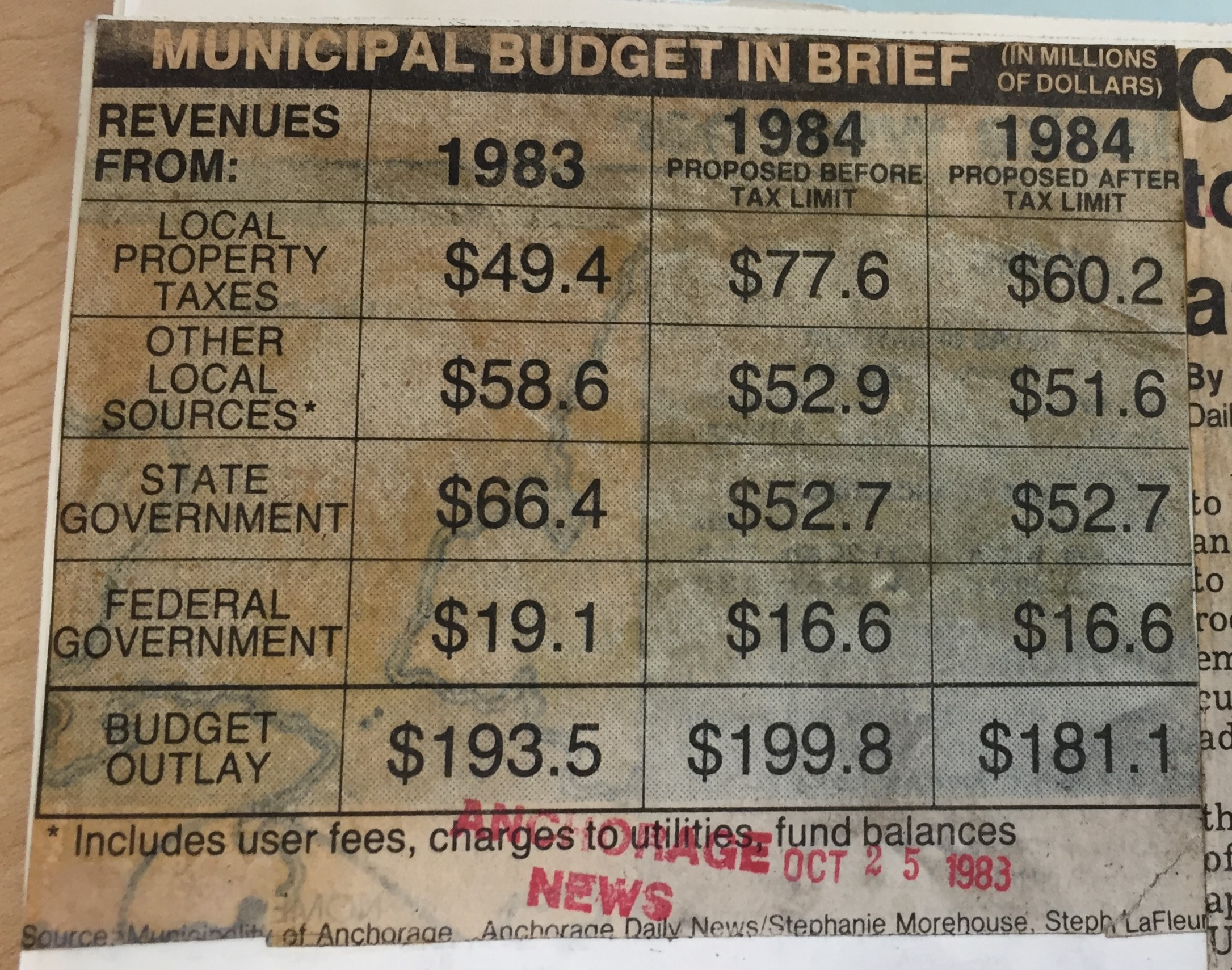
October 25, 1983 - A summary published by “Anchorage Daily News” showing how the proposed tax cap would limit government spending based on projected revenues. For reference, the State contribution to the Municipal budget in 2024 was $4.1M.
Published by the Assembly Legislative Services Office
We believe that local government plays a critical role in improving our community and that it works best when residents are engaged. We provide research, communications, and project management on behalf of the Anchorage Assembly to engage our community in local government. Learn more.