History Takes: Kameron Perez-Verdia
Representing West Anchorage on the Anchorage Assembly, Assembly Member Kameron Perez-Verdia co-sponsored AR 2019-426 and AO 2020-137(S), As Amended, to establish a formal relationship between the Native Village of Eklutna and the Municipality of Anchorage.
Now years following the formalization, he shared this perspective:
“Establishing a formal government-to-government relationship between the Municipality of Anchorage and the Eklutna Tribe was an important and long-overdue step in our city’s history. Given the difficult history between municipal, state, and tribal governments across the country, we wanted Anchorage to lead by example—by fully recognizing the Eklutna Tribe and committing to respectful, substantive engagement. Since the relationship was established, we have met regularly and worked together on issues that matter deeply to our shared community, including public safety, land and water, and K–12 education. It has been an honor to be part of this work, and it is encouraging to see how thoughtful and effective the relationship has become. I believe it will only continue to grow stronger over time.”
Most notably, the Native Village of Eklutna was excluded from the 1991 Fish and Wildlife Agreement that dictated the terms of the transfer of the hydroelectric plant from federal to local control. The hydroelectric power plant dammed the Eklutna River and blocked the spawning of our five salmon species. Even though the river is central to the Village’s history and culture and was the source of subsistence foods for Dena’ina people for hundreds of years, the Native Village of Eklutna was not given a seat at the table when the river was first taken in 1929, nor to help shape the future of the hydroelectric plant and restoration of the river. One of the architects of that 1991 Agreement, the late Congressman Don Young, later expressed regret for not making the Native Village of Eklutna a full partner in the Agreement.
In order to understand the modern history of relations between the Municipality and the Tribe, it is important to recognize that the Native village of Eklutna has been recognized by the Federal government for decades. Further, in the wake of the Alaska Native Claims Settlement Act (ANCSA), the North Anchorage Land Agreement (NALA), a federally authorized settlement instrument from the early 1980s, resolved contested land title issues in north Anchorage among the State of Alaska, the Municipality of Anchorage, and Eklutna, Inc. (the ANCSA village corporation.) It provides a structured process for conveying land entitlements, directs joint land use planning, and remains relevant for municipal planning, development, conservation, and intergovernmental coordination.
In 2007, under Mayor Begich, the Municipality made a step toward more formal recognition by signing two agreements between the Municipality and the Native Village of Eklutna. One was a Memorandum of Understanding for Coordinating Regular Meetings and Communications between the two entities, and another was an Intergovernmental Agreement for Coordinated Transportation Planning Activities. Recognizing the federal government’s long-held requirement for coordination with tribal governments, this was a major step forward in bringing that practice to the local level.
However, ten years later, the documents were outdated, forgotten about and/or were limited to functions of the Executive branch of the Municipality, and needed a formal update. The basis for the decision to pursue a formal relationship came because the Municipality recognized that while the Native Village of Eklutna is federally recognized as a sovereign tribe, the Municipality of Anchorage did not have a corresponding local relationship. The desire was for a formal, clear and lasting agreement with the hope that establishing protocols for government-to-government relationships would result in better outcomes over time for the Municipality of Anchorage and the Native Village of Eklutna.
History Takes:
Forrest Dunbar
Another sponsor of the founding legislation, Former Assembly Member Forrest Dunbar shared the following reflection:
“As my former colleagues on the Assembly continue to prove, there is great value in an ongoing, formal relationship with a federally recognized tribe, especially one that exists within your municipality. I'm proud that the passage of the ordinance was a process in which the Native Village of Eklutna played a central role-- in many ways, this was an Indigenous-led project.
But beyond the practical benefits of our meetings, the law also helps to educate residents of Anchorage and people in our Municipal government about the Native Village of Eklutna. I still believe it to be the case that many, if not most, people who live in Anchorage do not realize that we have a recognized native village, with its own tribal members, governance, and sovereignty, all within the legal borders of our community. Hopefully, the work that the NVE and the Assembly did and continue to do can help reveal and promote that fact.”
To begin the exploration of a more formal relationship, in 2019, then Assembly Member Constant invited fellow members Forrest Dunbar and Kameron Perez-Verdia to join President Leggett to propose and pass resolution (AR 2019-426) to initiate conversations with the Native Village of Eklutna. From there, the Assembly, in collaboration with the Native Village of Eklutna, spent the following year engaging in dialogue and deliberations toward a more formal relationship between the two governments, which included public meetings, working groups, and consultations with legal and cultural experts.
Ultimately, a government-to-government relationship and several accompanying policy changes were recommended, and on January 14, 2021, the Anchorage Assembly approved an ordinance (AO 2020-137(S), As Amended) to establish government-to-government relations between the Municipality of Anchorage and the Sovereign Native Village of Eklutna.
Since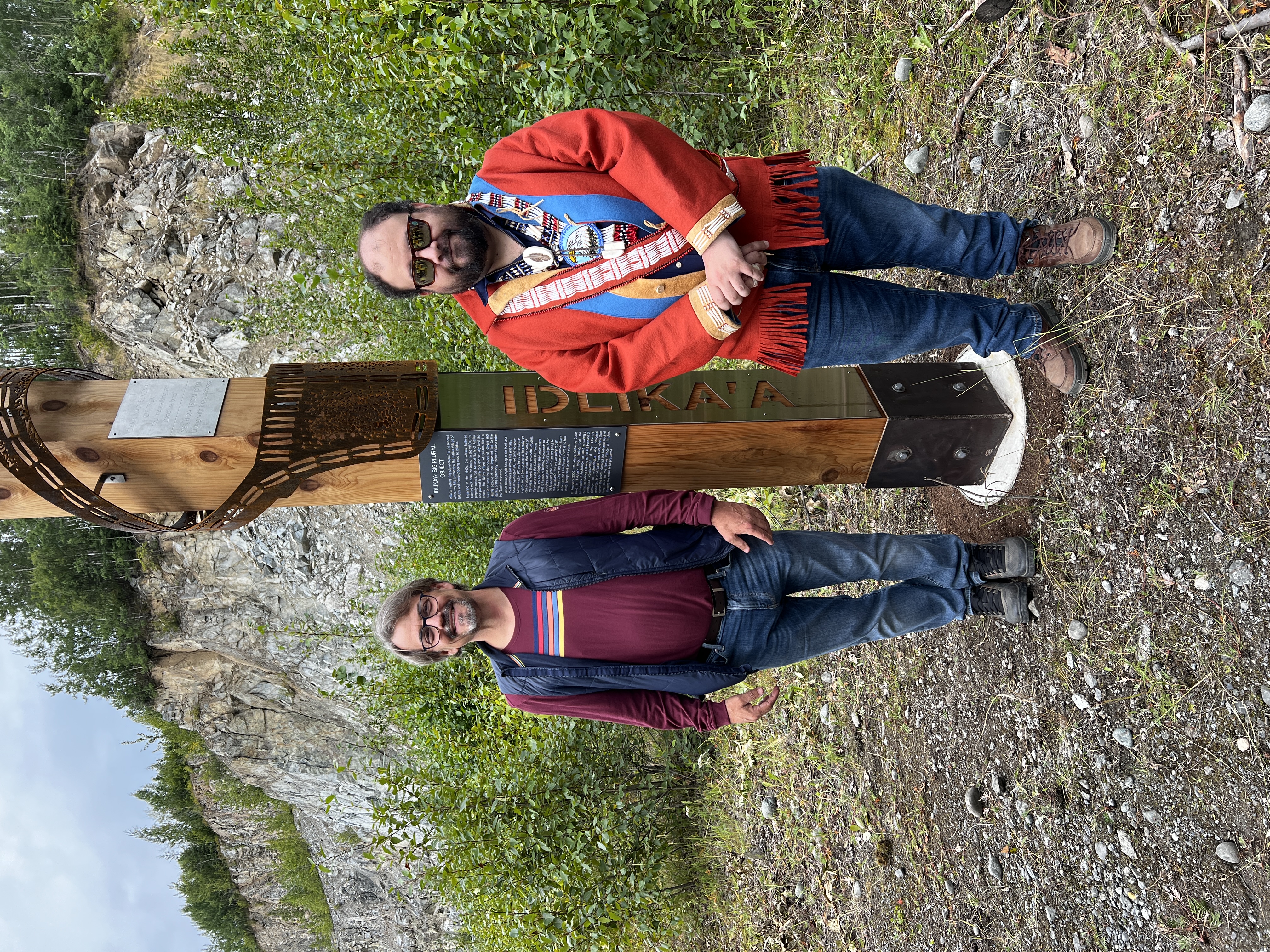 the passage of that historic legislation, the Anchorage Assembly and the Native Village of Eklutna Tribal Council meet twice a year to discuss items of mutual interest and ongoing initiatives shared by the two entities. Topics have included working together to address the housing shortage, improving public safety for the Municipality as a whole and the village of Eklutna, education, culturally relevant programs for youth, and the naming of municipal landmarks.
Following the success of the naming of the Dena’ina convention center, and more recent efforts to incorporate Dena’ina language and placenames into public spaces, in 2023 the Assembly updated its naming policy (AO 2023-48(S), As Amended) to add a consideration of traditional Dena’ina names when naming a new Municipal facility or road.
Pictured right: Assembly Chair Constant (left) and Native Village of Eklutna President Leggett (right) stand beside the Idlika’a place name marker, one of two at the Eklutna Powwow Grounds (August 3, 2024).
Perhaps the biggest, most consequential issue that the two entities have worked together on is the restoration of the Eklutna River. In 2022, the Assembly passed a resolution (AR 2022-262, As Amended) supporting efforts to restore the Eklutna River to enable salmon passage to and from the Lake. This resolution explicitly recognized that such restoration would benefit both Native Village of Eklutna and Anchorage residents, and the Assembly committed to work collaboratively with the Native Village of Eklutna, the power-project owners, state/federal agencies, and other stakeholders to implement restoration measures.
After research, joint meetings and coordination on the topic, in 2024 the Assembly and the Native Village of Eklutna passed their first joint resolution, Joint Resolution 2024-001. The resolution urged Governor Dunleavy to establish a final Fish and Wildlife Program for the Eklutna River that required the owners to explore alternative infrastructure options that could allow complete River restoration while protecting drinking water and energy supplies. The two entities continue to work on that project to this day.
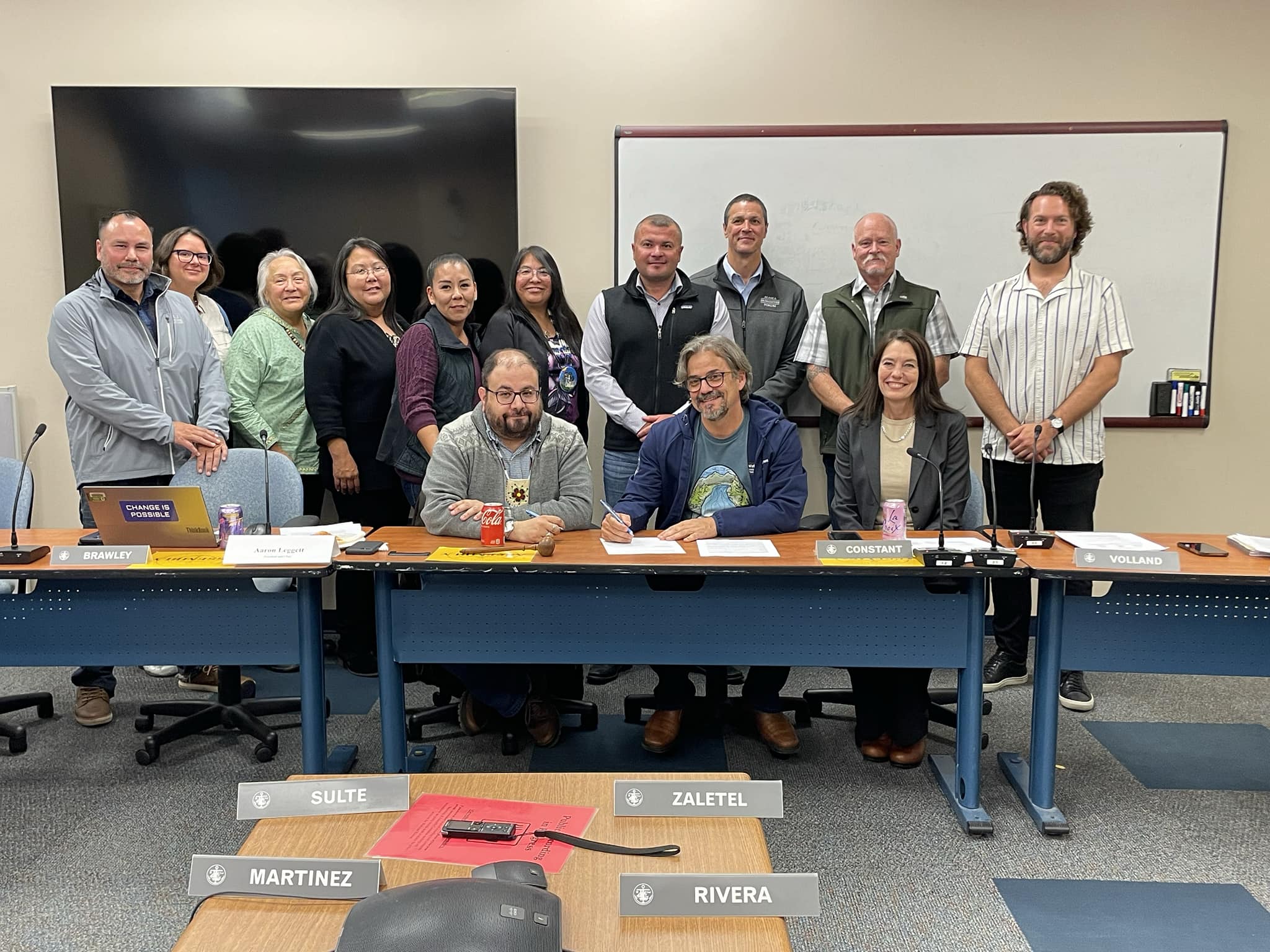
September 6, 2024 - The Native Village of Eklutna and Anchorage Assembly take historic action to approve Joint Resolution 2024-001 towards full restoration of the Eklutna River.
When thinking back on the 50th Anniversary of the Municipality and the joining of the city and borough governments, there really was a third government in the mix that was largely ignored during those conversations. The official government-to-government relationship established in 2021 was long overdue, but now that it’s in place, we have a major opportunity to leverage the strengths of both governments for the benefit of everyone in our community. It’s exciting to think about how the Native Village of Eklutna and the Municipality of Anchorage can work together to meet the needs of our entire citizenry over the next 50 years.
Published by the Assembly Legislative Services Office
We believe that local government plays a critical role in improving our community and that it works best when residents are engaged. We provide research, communications, and project management on behalf of the Anchorage Assembly to engage our community in local government. Learn more.