By 1916, Anchorage had a population around 6,000 and two fire departments, one protecting the city and the other, a federal fire department, protecting the federal railroad properties. The city fire department was located in the alley between 4th and 5th Avenues, just off F Street between E and F. The department was staffed with volunteers who used horse drawn apparatus and a hand pump.
In 1921, the Anchorage Fire Department received its first motorized fire apparatus (pictured below). The city and the federal railroad fire department (under the Alaska Engineers Corps) each ordered one for $11,000. The two fire engines had consecutive serial numbers, but the AEC fire engine wasn't delivered until 1922.
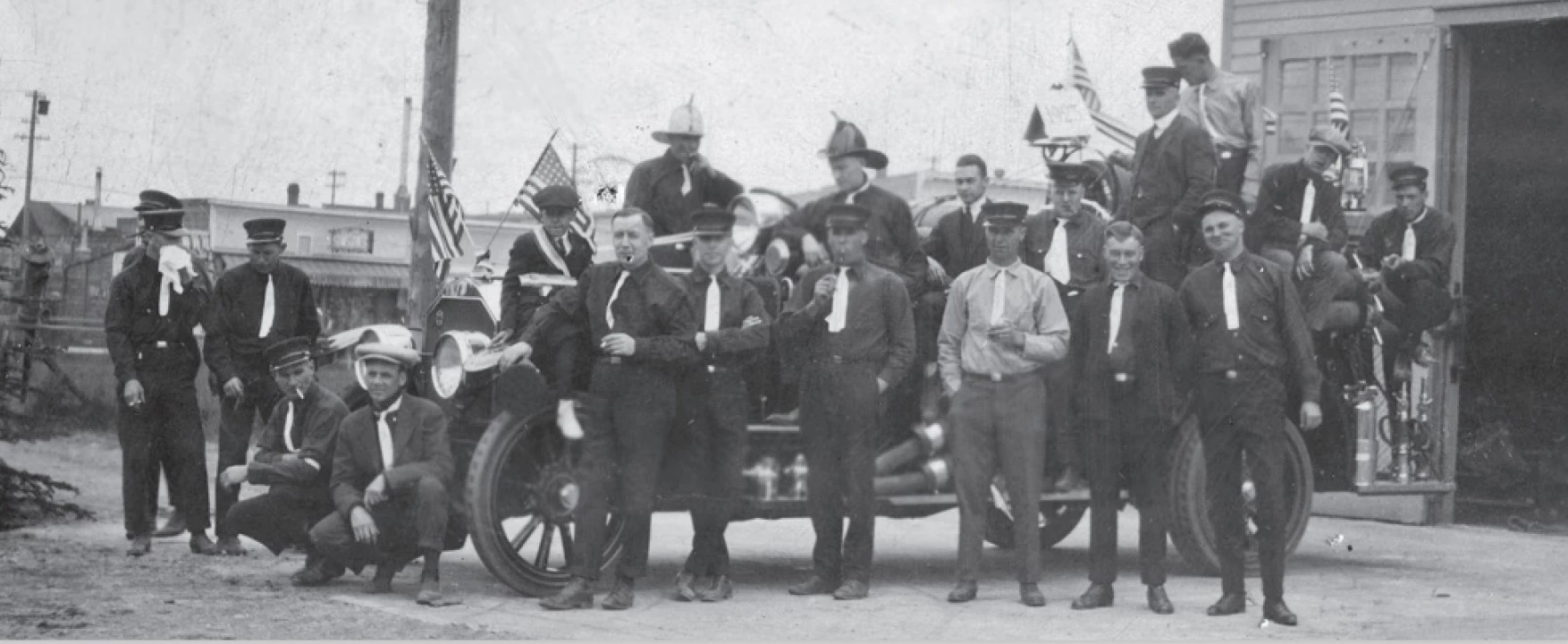
Anchorage Fire Department, 1924. Thomas "Tom" Bevers is the man standing third to the right of the vehicle’s front tire. At the time this photograph was taken, Bevers was a paid firefighter in a mostly volunteer fire department. B1978.111.25, Carl Lottsfeldt Collection, Atwood Resource Center, Anchorage Museum at Rasmuson Center, Anchorage, AK.
The fire chief at the time, M.J. Dolan, argued that horse-drawn apparatus would be superior to motorized apparatus in Anchorage's snowy winters. Dolan owned the horses that were leased to the city. Dolan was fired when the new engine fire arrived and the carburetor was discovered missing, later found in a grain box.
Anchorage acquired its first aerial ladder truck in 1948, a 65-foot American LaFrance.
In 1956, the department requested compensation equal to the police department, which was denied.
The
Rabbit Creek Volunteers was an all-woman firefighting squad formed in 1962. The women firefighters had the same status as male volunteers.
In 1955, the Anchorage Fire Department assumed responsibility for protecting the federal railroad fire department from the Alaska Engineers Corps.
The Greater Anchorage Area Borough, established in 1964, began forming fire districts in 1966 and recruiting firefighters and chiefs. Tensions between the borough and city fire departments were growing.
On Jan. 13, 1970, there was a fire in the Gold Rush Motor Lodge on Northern Lights Boulevard, just outside the Anchorage city limits, resulting in five fatalities (pictured below). Firefighters from both the borough and city responded, but fire commanders from the Anchorage Fire Department refused to assist the GAAB firefighters, watching from the other side of the street. (Some AFD firefighters broke ranks and provided assistance.)
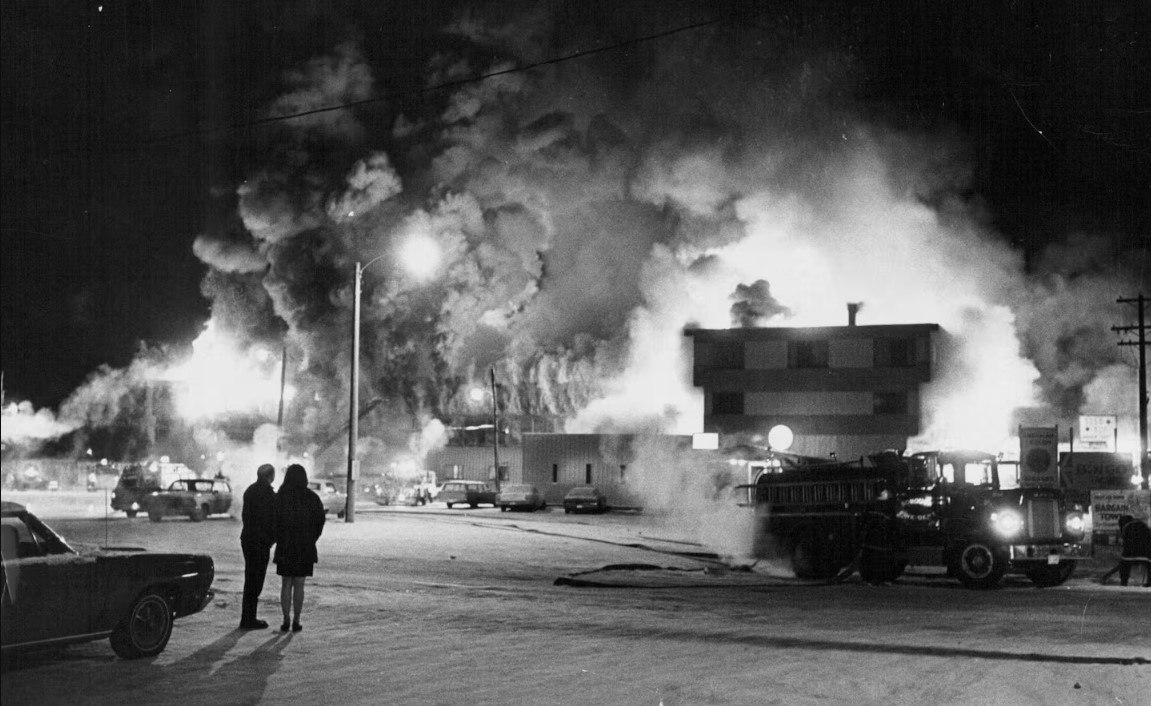 WALLS OF FLAME SWEEP LENGTH OF MOTEL - Searing flames quickly destroyed the Gold Rush Motor Lodge on Northern Lights Boulevard, at the southern City limits of Anchorage today, sweeping from the front dining room area at the right of photo along the length of building, to the left in the picture. State Troopers reported that 34 rooms, were occupied when the fire broke out, with between 40 and 43 persons in the building on the time. January 1970, credit of Anchorage Daily News.
Ambulance service throughout the area was provided by the borough fire department, consisting of the Sand Lake, Rabbit Creek, Spenard, Tudor, and Muldoon fire stations. The city fire department staffed the Downtown, Government Hill, and City View (Airport Heights) fire stations. The Borough started a paramedic program in 1972. Participants were recruited from among the city and borough fire departments.
The GAAB and the City of Anchorage merged to form the Municipality of Anchorage in 1975. At the time, the city fire department employed 107 personnel and the borough, 122. There were two fire chiefs and numerous duplicative job titles, different shift schedules, two unions, and different pay grades.
In the late 1980s, economic downturn resulted in the closing of the Government Hill station, closing of several companies (Engine 2, Squad 1, Truck 12, Tanker 6, and Tanker 7), elimination of the 24-hour fire investigators, and the layoff of 24 firefighters. Of these, only Truck 12 and Engine 2 have since returned to service. Engine 2 (Government Hill) reopened at the downtown fire station.
In the 1990s, AFD paramedics prevailed in a lawsuit that awarded large sums of overtime back-pay. The Fair Labor Standards Act, at that time, allowed firefighters to be paid overtime above 53 hours per week, instead of 40 hours per week as it is for most other types of employees. Since the paramedics were no longer firefighters, they were entitled to back pay and additional overtime going forward. To remedy this, the AFD cross-trained all paramedics as firefighters and all firefighters as emergency medical technicians (EMTs). Firefighters began working on ambulances and paramedics began serving on fire engines, leading to fully integrated dual-role system we have today.
Name a few key staff or community members that have shaped your department and share one or more stories that reflect their impact.
Anchorage's first full-time fire chief was
Thomas Stokes Bevers, who served from 1927 to 1940. He was active in the community and devoted to growing our city. He bought and developed land establishing the community of Fairview. He helped organize the first Fur Rendezvous and served two terms on the Anchorage City Council. As a Black man,
Bevers was a notable community member during an era when open discrimination was tolerated. He is interred in the Anchorage Memorial Cemetery.
Learn more about Tom Bevers.
Where can people learn more about your department’s history?
Visit the Alaska Fire Service Museum at Anchorage Fire Department Headquarters, 100 E. 4th Avenue, Anchorage.
On November 23, 1922, there was a fire at the Jonesville, Alaska coal mine, 60 miles northeast of Anchorage. Since Anchorage depended on coal from the mine, the one-year-old 1921 American LaFrance fire engine was dispatched to fight the fire, transported on a railroad flatcar. The engine pumped nearly continuously for 13 days, interrupted only briefly to change the oil and replace a broken hose. This set a record for continuous operation on a fire which, we believe, stands to this day. The sister to this fire engine, the railroad (AEC) 1922 LaFrance, is on display at the Anchorage Fire Museum.
The information presented here was compiled from numerous sources, in some instances with conflicting dates and details. This is our best good faith effort to provide an accurate and interesting summary of the history of the AFD.
We believe that local government plays a critical role in improving our community and that it works best when residents are engaged. We provide research, communications, and project management on behalf of the Anchorage Assembly to engage our community in local government. Learn more.