History Takes: Bill Falsey
Bill Falsey is currently the Chief Administrative Officer for the Municipality of Anchorage, overseeing internal operations and functions.
He served as Anchorage's municipal manager from 2017 to 2020, and as Anchorage’s municipal attorney from 2015 to 2017. He served as incident commander overseeing Anchorage's on-the-ground response to the COVID-19 pandemic, and helped Anchorage through the Nov. 30, 2018 7.1-magnitude earthquake.
Mr. Falsey has served as a board member, or in a leadership role, in numerous civic and non-profit organizations, including the Railbelt Reliability Council, the United Way of Anchorage, Best Beginnings , the Arc of Anchorage, as well as the Municipality’s Board of Ethics, and legacy Police & Fire Retirement System.
Pop Quiz: Is Anchorage a city or a borough? (Or neither?)…and: does it matter?
Answer: formally, the Municipality of Anchorage is a unified borough—and, in at least one significant way, it does matter: practically, it’s meant that Anchorage largely governs itself through “service areas.”
The Alaska Constitution recognizes only two forms of local government: “All local government powers shall be vested in boroughs and cities.” Article X Local Government, § 2. At unification, the Municipality had to end up one or the other.
While cities generally operate on an “areawide” basis, the Alaska Constitution permits boroughs to establish “service areas” to provide “special services” to less than every part of the borough. Article X, § 5 Service Areas.
That was an attractive option to former Borough residents in 1975, and it’s the path Anchorage took: the Charter dissolved the “former cities of Anchorage, Girdwood and Glen Alps,” and provided that they “shall become service areas.” Anchorage Municipal Charter §§ 19.09,19.16.
The Charter allowed services to expand beyond the boundaries of the former cities by providing that new service areas could be established (and existing service areas could be altered), if approved by “a majority of those voting on the question within the area affected.” Id. at § 9.01(a). Today, the Girdwood Valley and Glen Alps service areas are still among the more than 40 service areas we have on the books. See Anchorage Municipal Code 27.30 Service Areas.
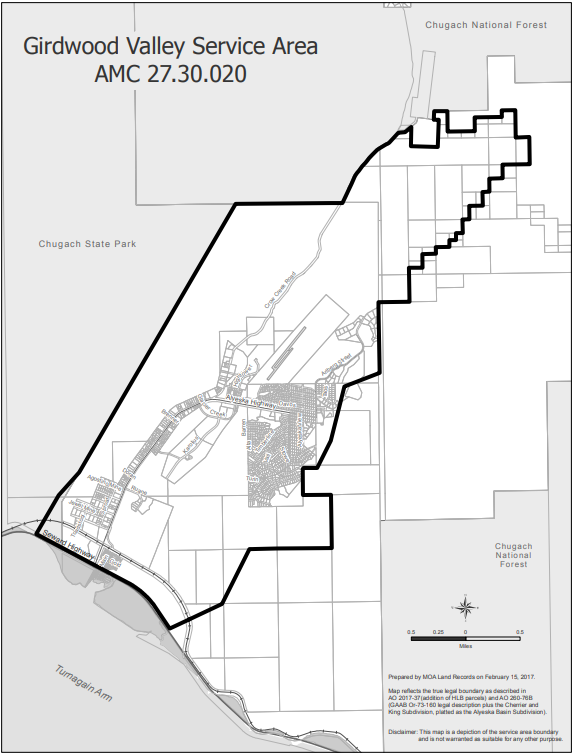
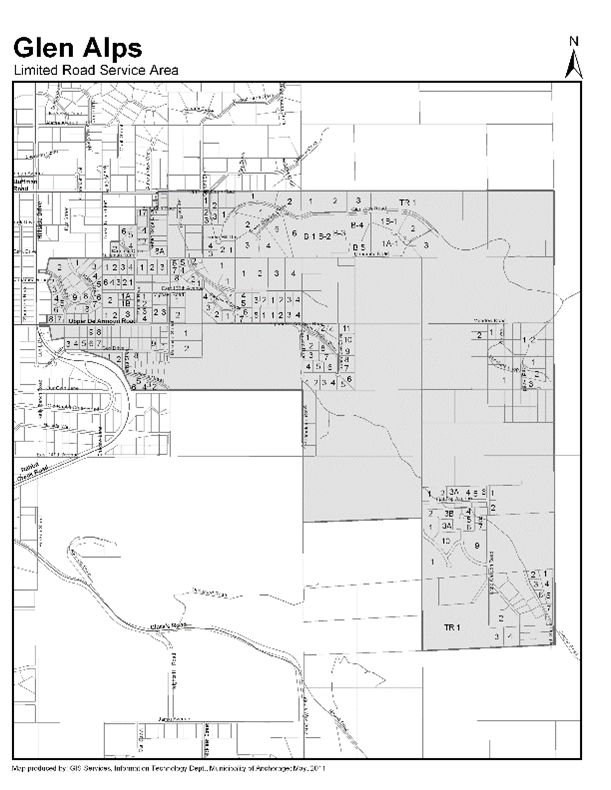
The Girdwood Valley Service Area and Glen Alps Limited Road Service Area today.
The Charter also allowed the Assembly to administratively “consolidate service areas in which services are provided by the municipality at the same level,” Charter §9.01(a). And that’s what occurred for major government services: police, fire, parks, and, to a much lesser extent, roads.
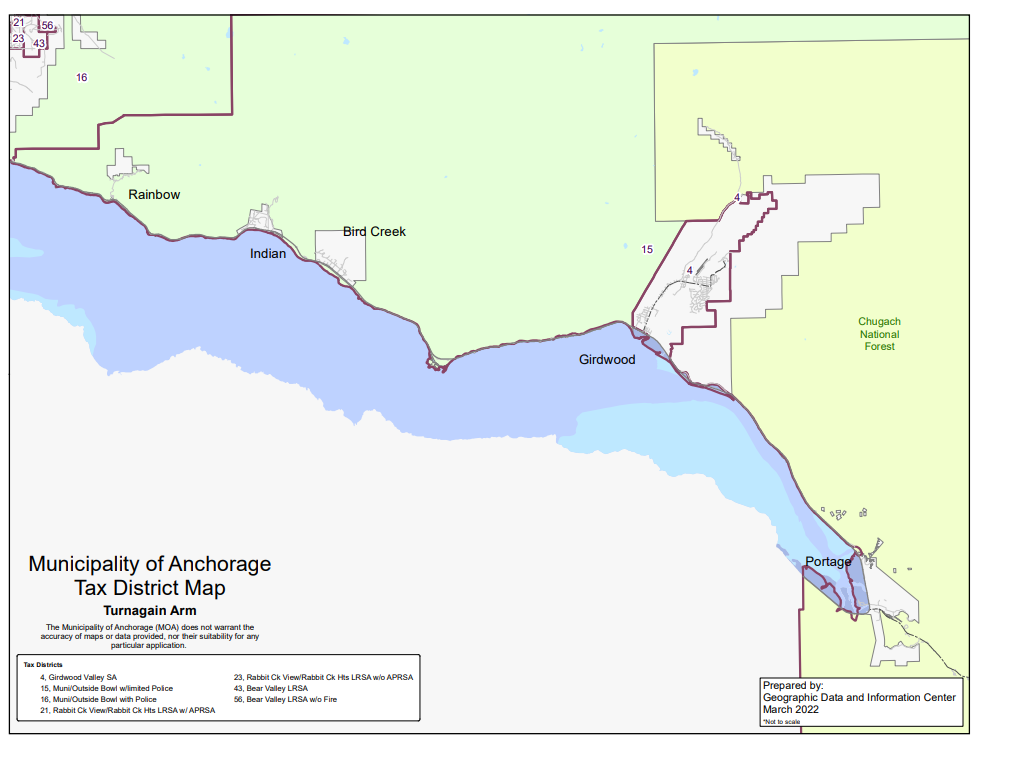
But it’s also left us with a patchwork of administrative boundaries and accounting challenges that occasionally mean the government has to give the unsatisfying answer, “we’re not authorized to work there” (such as when the Alaska State Troopers announced they would no longer police the Turnagain Arm).
To this day, Anchorage collects relatively little “areawide general” taxes – a typical tax bill is mostly levying dollars that can only be used in a particular service area, for the particular service area’s functions: police dollars, fire dollars, parks dollars, building-safety dollars, or road dollars.
As a home rule municipality, the Anchorage Assembly can elect to take a service-area power areawide, and it has. (“Library” powers were initially exercised only a Library Service Area, but were quickly taken areawide. See AO 1976-19; AO 1977-197. That model was later followed when the Assembly declared “highway law enforcement” to be an areawide power, to fill the gap left by the Troopers.)
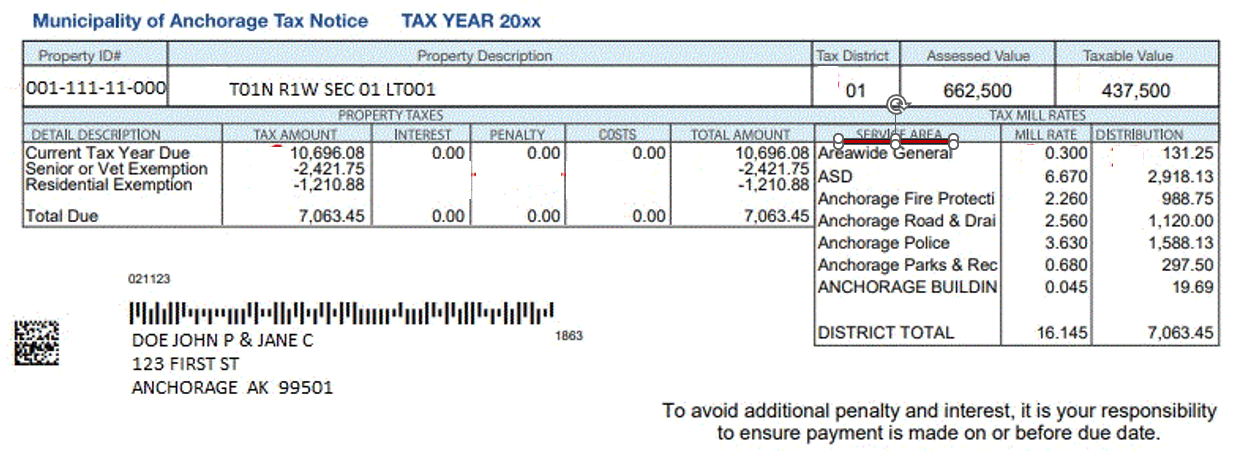
Look familiar? This is a sample tax notice, showing mill rate by service area.
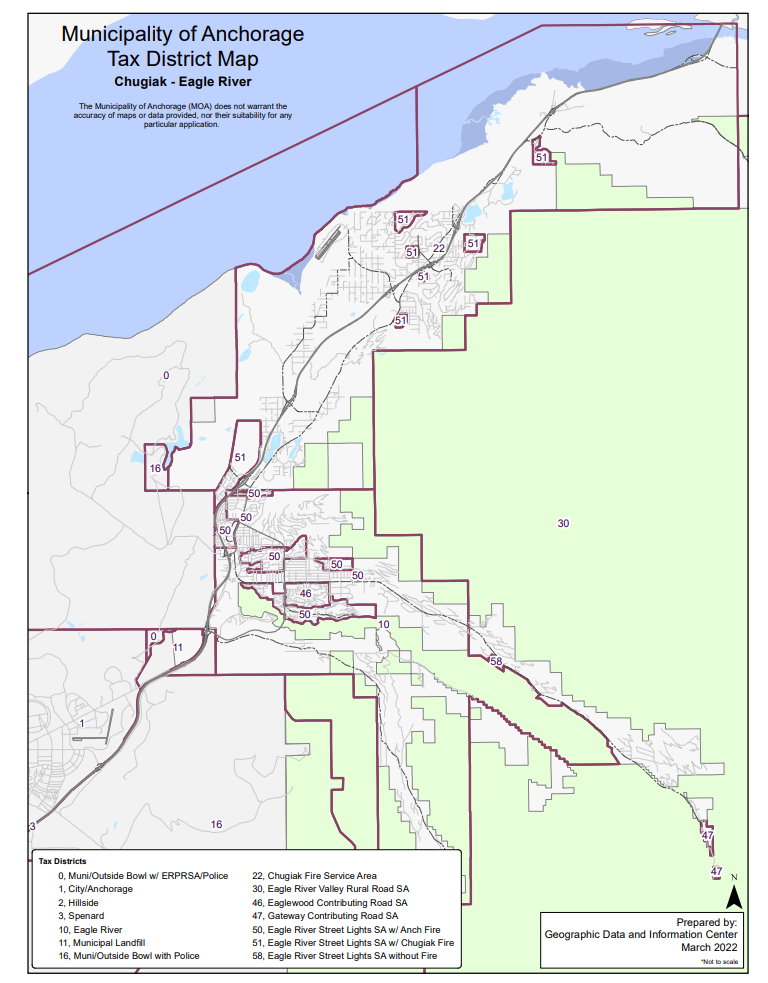
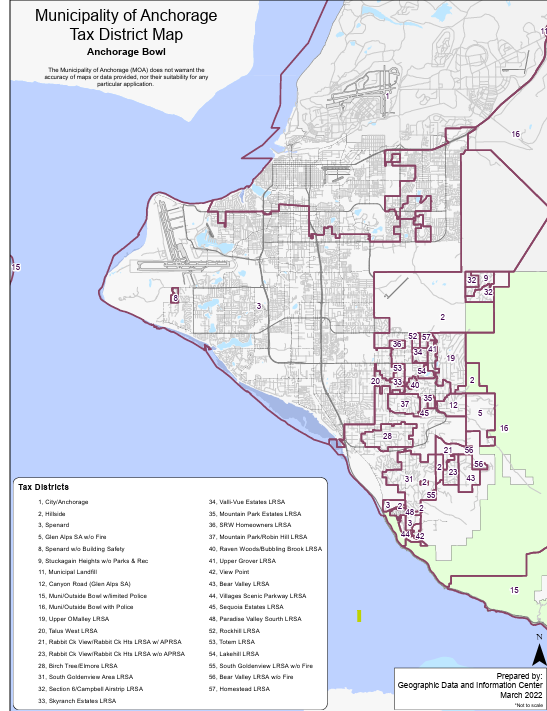
But the chiefly perceived advantage of the service-area concept is that it has allowed citizens to vote themselves into the level of government they want, and to retain a measure of local control. Residents in Girdwood and Chugiak exercise police, fire, parks and road powers through local boards that operate in a distinctly different manner from how similar services are provided in the Anchorage Bowl. And because areawide solutions would erode those distinctions, the service-area concept—which presently requires the Municipality to track and account for 58 different tax districts as pictured below—is likely to remain central to what the Municipality of Anchorage “is,” for a very long time.
Published by the Assembly Legislative Services Office
We believe that local government plays a critical role in improving our community and that it works best when residents are engaged. We provide research, communications, and project management on behalf of the Anchorage Assembly to engage our community in local government. Learn more.